Kiev 88
I bought my first medium format film camera: the Kiev 88. Is it any good?

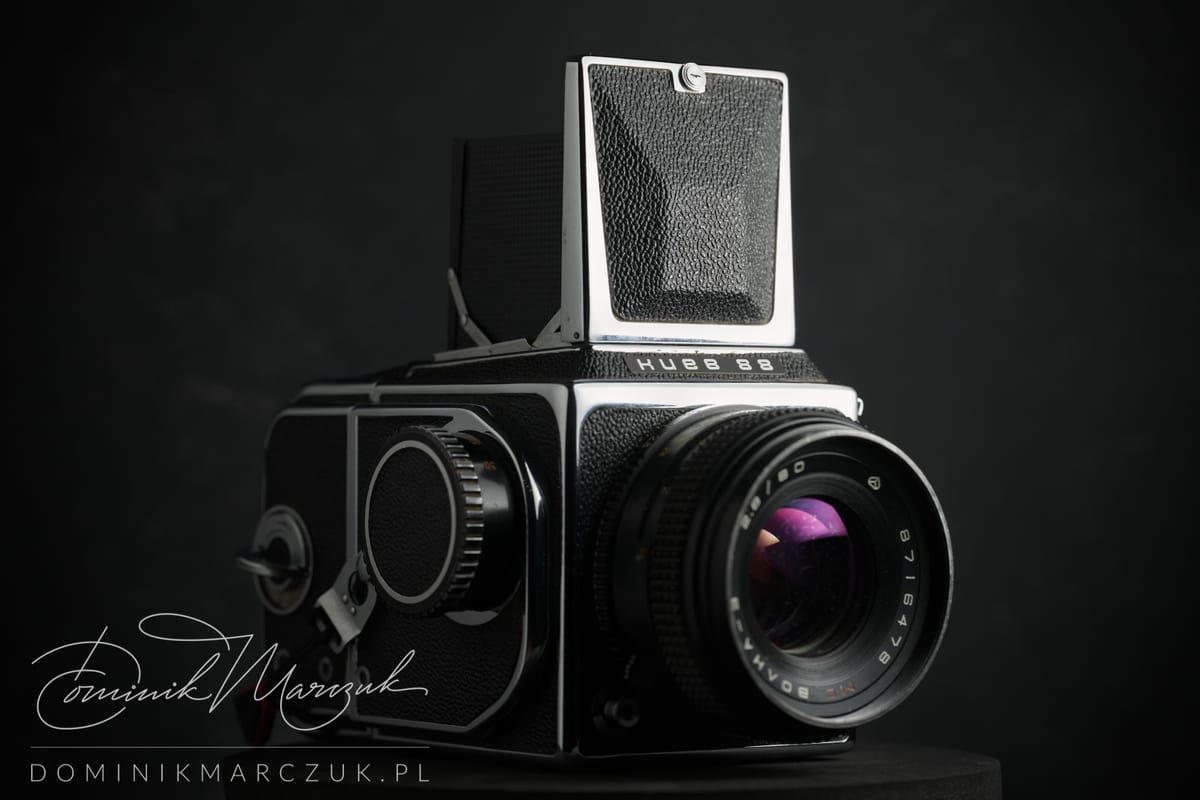
When reviewing the Pentax 645, I mentioned having drained my savings on another camera. The Kiev 88 was it. It’s a Hasselblad knockoff, just less reliable, earning it the nicknames Hasselbladski or my favourite, Hasselblyad’. The camera took a while to ship from Ukraine; so long that I managed to buy the Pentax 645 in the meantime, receive it and thoroughly test it.
 Dominik Marczuk
Ultimately, the Kiev 88 arrived safely. The kit contained the camera body, a waist-level finder, the MC Volna-3 lens, two film backs, a strap, a leather case and an original box. It was advertised on eBay as "professionally serviced" and free of defects. Still, I knew very well that I was in for a world of pain. On that point, the camera delivered.
What Is It?
So, what is a Kiev 88 anyway?
Its direct predecessor was called Salyut, which I've always found an interesting name, since when written in Cyrillic, it bears an uncanny similarity to the word "Canon". I'm not convinced it was intentional. Anyway, the Salyut was a knockoff of the Hasselblad 1600F. Visually, the Kiev 88 is hard to tell apart from the Hassy.
It's a medium-format camera that uses 120 film and shoots 6x6 images. It's got a focal plane shutter, unlike many 6x6 cameras that tend to use leaf shutters in the lenses. Still, it's capable of achieving a 1/1000" shutter speed, which wasn't available even on newer constructions. It doesn't have mirror lockup, so slower shutter speeds may be susceptible to camera shake.
The camera is infamous for its quirks and unreliability. Film backs leak light, frame spacing is inconsistent, and it's very easy to leave a blank frame if one doesn't understand how the Kiev 88 works. It's objectively a terrible camera that remains somewhat popular due to its price, five to ten times cheaper than the Hasselblad.
First Inspection
Upon the initial inspection, everything was more or less OK. The lens had some marks on the front element (likely coating degradation), but nothing that would visibly influence the image quality. I also noticed that the mirror bumper was completely disintegrated; tar-like remains were stuck to the lower edge of the mirror, and the rest was completely gone.
I checked the basic functions, and they seemed to work fine: I could cock the shutter, fire it, and change shutter speeds, which sounded plausible. The lens was also functional, disregarding the marks on the front element: the focus and aperture rings worked great, and the depth of field preview was fine.
The camera body has a serial number starting with "87", which indicates the year of production. The film back that was attached to the camera is from the same year. The spare one is older, dating back to 1980. There’s nothing wrong with the date discrepancy; it only tells me the items I received weren’t originally part of the same kit.
Overall, I was optimistic about the equipment.
First Roll
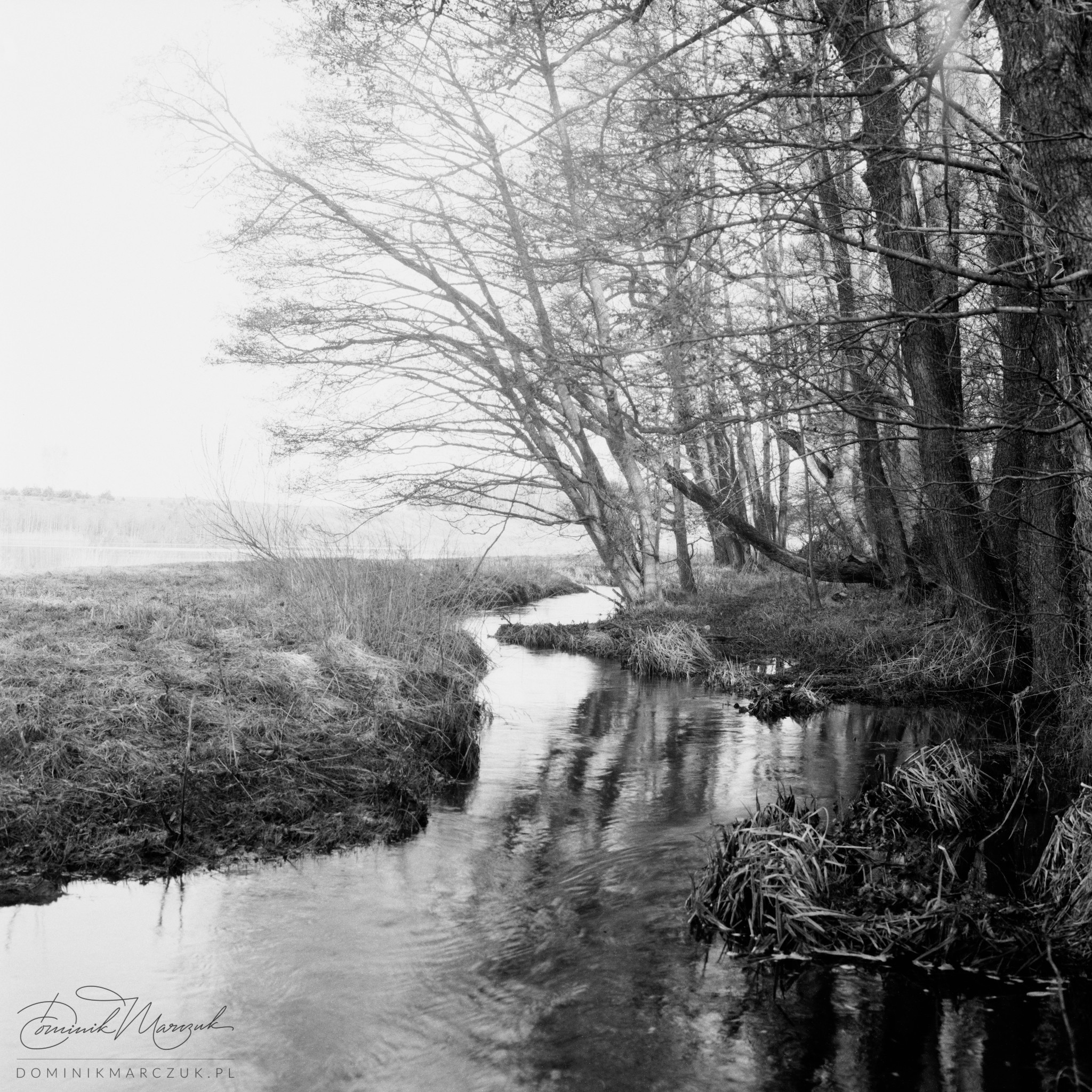
I set out to test the camera. I cautiously used the cheapest film I could find: Fomapan 100. To the Kiev 88's defence, I have to say the photos turned out decent. Out of the twelve frames, two were good, and one was an absolute banger. Things weren't rosy though.
First off, all twelve frames had a light leak on the left edge. This told me the newer film back required a light seal replacement. Second, some frames (coincidentally, all used 1/60 second shutter speed) had vertical streaks of uneven exposure. They were mostly fixable in post, but it was quite clear that the shutter curtain movement wasn't very even.
The frame spacing issue that plagues all Kiev 88 cameras was mild: all frames required only a gentle nudge to get exactly to the next frame. I believe they wouldn't overlap had I forgotten to advance the film manually, and I'd successfully fit all twelve of them on the film.
A few frames were misfocused. I didn’t think much of this until much later.
Second Roll
The cheapest film I had in the fridge was Ilford PF4 Plus. Objectively, it's not the cheapest thing on the market, but I’d got it on sale. I used it to test the second film back. I already knew the issues with the first one and wanted to know the exact extent of servicing that I needed to request at my local repair shop.
Frame spacing was off again, though similarly to the first back, the frames didn’t overlap. I lost one due to my own mistake: I wound the film to the first frame, installed the film back onto the camera and cocked the shutter, which wound the film to frame 2. By the time I realised my mistake, I’d already taken a few shots.
More importantly though, the gears in the older film back were so stiff that they ground and jumped. After the initial two or three frames, I had to resort to removing the film back, cocking the shutter, advancing the film manually and reattaching the back. "Inconvenient" is an understatement.
The developed film was warped along one edge and had light leaks much more severe than the previous one. The older film back required servicing too. Luckily, no streaks of uneven exposure were present on the neg, possibly due to the fast shutter speeds I’d used.
The most infuriating thing was the rate at which I’d missed focus. I examined the frames from both rolls and realised the camera had focusing issues: the ground glass wasn’t aligned with the film plane.
It was at this point that I believed I knew all I needed to describe the issues to the technician at the service shop.
I also contacted the seller and described the problems, indicating that the camera in fact hadn’t been serviced. They grumpily replied that I had provided no proof of the issues, but eventually offered to reimburse me with 15% of what I’d paid. It was roughly the cost of having the camera serviced, so I agreed.
Post-Repair Use
Luckily, the techs at the repair shop were able to fix all of the issues. The focusing misalignment required two attempts, but eventually was rectified. The film backs were sealed properly, and the camera has received a CLA.
The issue with the Kiev 88 is that when it works fine, it’s still quirky, unreliable and a general pain in the behind. I've had moderate success with the camera, but noticed that the film backs started spacing the frames farther apart, forcing me to remove the film back between frames and wind film manually. Also, light leaks quickly reappeared (not as severe, but still).
The focusing screen on this thing is typically described as dim. I find that it's totally usable in most conditions, even on sunny days. It would be great if it were brighter, but for me, it was perfectly sufficient. Also, it can be swapped, and if I were desperate, I’d be able to order a decent screen, say, from Rick Olesson. I can’t rightfully justify the purchase of a focusing screen that costs half as much as the entire camera kit did - but I have the possibility to do so.
The lens is fine, but nothing beyond that. It’s not as sharp or contrasty as I’d like it to be, but it’s decent enough. The marks on the front element don’t seem to influence the image quality in the slightest.
What I absolutely despise is the lack of any form of mirror lockup (MLU). The 6x6 mirror is huge, and its slap is ground-shattering. I’m genuinely surprised my shots came out as sharp as they did. The massive focal plane shutter isn’t making my worries any smaller. The camera shakes perceptibly when it’s taking a photo, and if it weren’t for a sturdy tripod, I’d likely see some blur on the images. I know it’s a copy of a Hasselblad, which had the same features, so I wasn’t expecting an in-lens leaf shutter, but I never realised I’d feel insecure about the quality of my photos.
The slower shutter speeds use a strange mechanism for timing the movement of the shutter curtains. It’s also a Hasselblad copy, not a Soviet invention, but it’s still unusual: there’s a propeller inside that delays the closing of the rear curtain. I don’t really care what mechanical trickery is involved there, but the whizzing sound it makes is certainly something I haven’t heard in any other camera.
The film winding was the absolute worst user experience. Inconsistent frame spacing, frames wasted due to user error, grinding gears and having to detach and attach the film back over and over again; that's not my cup of tea.
Summary
My Kiev 88 works. It's quirky, it's unreliable, but it works. It's exactly what the Internet community describes it as, but at least it takes photos. But it's not pleasant to use, it's not fun. I will not be keeping it; I prefer to resell it and buy another camera instead, likely a TLR, given that I already have another 6x6 SLR that I actually like. Shooting with the Kiev 88 is possible, and it's capable of taking banger shots. It's just not what I expect from a camera.
Feel free to take a look at some of the images taken with my Hasselblyad’. There aren't many, and there won't be any more.